For the majority of cases, a patient needs to undergo an x-ray in order to determine if they have suffered slipped vertebrae. So, logically, the prevention of slippage of the vertebrate is not easy unless we routinely x-ray all people. The issue needs to be further considered and explored.
You should seek the help and support of a doctor about your back if you have persistent back pain for more than 2 weeks or if you are suffering from leg or calf pain on the same side or same area. If you suffer from these or similar symptoms, you should seek the advice of a specialist doctor for diagnosis immediately.

The patient with the 4th and 5th vertebrate slippage
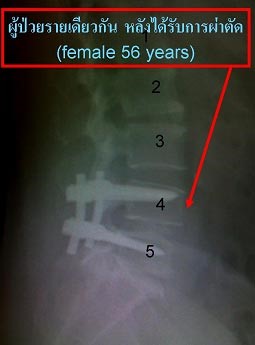
Same patient after the operation (56 years old female)
The pictures show the patient before and after the back operation
If you have suffered vertebrate slippage, you first need to know the severity of the slippage. Will you suffer additional slippage? How strong are the vertebrate and back muscles? And how long can they uphold the use in daily life?
The doctor needs to examine the strength of the back muscles, particularly at the waistline (Para spinal muscle). Is there any fibrosis caused by chronic inflammation to the back muscles and vertebrate tendons, and at how many locations? Is the leg muscle weak, or whether the vertebral nerve is pressed or is degenerating, and how far progressed is the condition?
Note: Spondylolisthesis is pronounced ‘spondee-lo-lis-thee-sis’
The examination data is important for the continuous treatment and the management of body movement in daily life. Do not bend down too often or lift heavy things. It is important to manage your body weight carefully. Most importantly, exercise daily to strengthen the back muscles. The process of “Active Training Muscle Exercise Type†is the only quick fix to get the degenerated muscles back to normal. This exercise will be will explained in further detail later.
If you have suffered vertebrate slippage, you first need to know the severity of the slippage. Will you suffer additional slippage? How strong are the vertebrate and back muscles? And how long can they uphold the use in daily life?
The doctor needs to examine the strength of the back muscles, particularly at the waistline (Para spinal muscle). Is there any fibrosis caused by chronic inflammation to the back muscles and vertebrate tendons, and at how many locations? Is the leg muscle weak, or whether the vertebral nerve is pressed or is degenerating, and how far progressed is the condition?
The examination data is important for the continuous treatment and the management of body movement in daily life. Do not bend down too often or lift heavy things. It is important to manage your body weight carefully. Most importantly, exercise daily to strengthen the back muscles. The process of “Active Training Muscle Exercise Type†is the only quick fix to get the degenerated muscles back to normal. This exercise will be will explained in further detail later.
In cases where the slippage has not pushed vertebrae too far apart, you can live a normal life. But, should the problem be neglected, an increase in body weight or not seriously taking the precautionary measures outlined above, slipped vertebrate will move further and further apart each year. This will lead to nerve compression by the bone. At this point, the only way to rectify the problem is to undergo a surgical operation.
Prior to the operation, a diagnosis must be undertaken to identify risk. A diagnosis consists of a general medical examination including your specific health problems, a heart examination, and finally an examination by the anesthetic physician.
The operation to cure the spondylolisthesis consists of 3 main steps
The patient with the 4th and 5th vertebrate slippage
1. The reduction and fixation step
The slipped vertebra will be fixed and returned to a normal position to reduce the slippage distance, by using a special metal (Medial Grade Metal). The success of this operation depends upon the condition of the bone mass and if the bone is strong enough to be the base of the metal fixation. The method cannot be applied to a patient who has low bone mass or has thin or porous bone as the metal will easily loosen. If the patient does suffer from the above issues the only options are to treat the condition using the second and third steps.
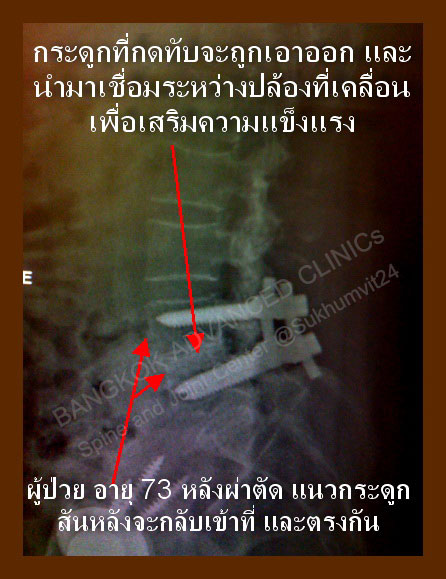
The bone that compresses the nerve will be removed and used in mending the slippage of the vertebrate Our 73-year old patient after the operation; the vertebrate were brought back to positions and in a straight line
2. Decompression Step
The complete removal of the tissue or the extra bone that presses on the nerve is a crucial step. The removal of all the pressure allows the blood circulation to return and to transport the nutrients supply to the nerve. The inflamed/degenerated nerve will be able to recover quickly. The step aims to recover the damaged nerve in the canal of the slipped vertebrae.
3. Fusion Step
Bone graft, using bone from the removed bone that compressed the nerve, from step 2, or using synthetic bone grafts, the problem vertebrae are welded back together. Small pieces of bone graft will be placed on the backbones that have slipped. Acting as glue, the graft allows the slipped bones to naturally fuse. This will make the bone even stronger than before. This step has many complex decisions that require deliberation, such as where to weld, how many spots, and which sides to weld. The purpose is to tighten the loosened point of the slipped joints and to get them back to strength. This step is known as “the security of the vertebraeâ€.
Following this procedure, the patient need to rest for 2-3 days in bed before being allowed to sit up (with the back supported). Following this rest period the patient and can start walking. In all, the patient is required to rest in the hospital for 5-8 days. The recovery time is dependent on the individual, and governed by each person’s health and how severe the symptoms may be. Often, patients delay the operation, trying other alternatives, hoping to avoid the surgery. However, the longer the delay, the longer the recovery of the nerve cell will take.
Around 1 month recovery time is required following the operation. Subsequently, patients will need to build up back muscle strength by “Active Training Muscle Exerciseâ€. This is essential to gain back the strength to continue with daily life. Whilst the operation can only fix the problematic vertebrae and nerves, there will be more vertebrae that have not been operated on. Strong back muscles are needed to maintain the stability and strength of the entire waistline vertebrae to handle daily life, otherwise there is a chance that other vertebrate will slip out too.
After the vertebrate is repaired and secured the nerve cells are recovered and back to normal again. You will be able to walk for longer, stand up for longer without pain in the calves or suffering backache. Surprisingly, some patients are even able to pick-up their favorite sports again.
Wishing you all healthy lives without backache.