


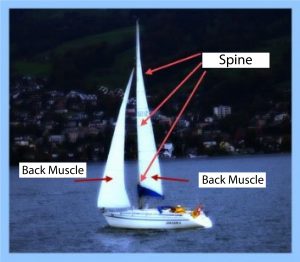
The structure of our backs is very similar to that of a sailboat sailing across the sea with its sails fully extended. As we stand we are fighting the natural force of gravity.. We are able to stand due the vertebrae (spine) and strong muscles in our back in the same way that a sailboat can stand thanks to the strong supporting ropes on both sides.
Like the sailboat facing many forces, our backs face many forces in daily life. We are often unaware how hard and how much strain that our backs are put under every day from, the moment we wake until we go to bed.
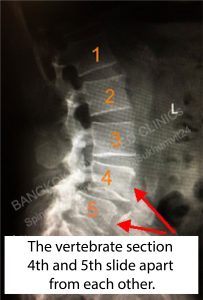
The vertebrate at the waistline (lumbar spine) consists of 5 connected sections. Each section has a joint and tendon that strongly and securely supports the connection. When we move, bend or rotate the body, each section of the vertebrate synchronize and works together without slipping or colliding with each other.

In normal day-to-day life, there are some circumstances that cause these vertebrate sections to slip out of place, particularly slippage from their adjacent section.
- Dysplastic Spondylolisthesis, the incomplete growth of the vertebrate
- Spondylolytic Spondylolisthesis, this occurs when there is not enough or limited blood supply. As we grow up, these 2 conditions cause weak connections. When we endure vibration forces to the back, the connection is then gradually pushed apart.
- Degenerative Spondylolisthesis, occurring due to arthritic changes in the joints of the vertebrae due to degeneration. Due to time caused nature of this condition, it is more common in older patients.
- Traumatic Spondylolisthesis, due to direct trauma or injury to the vertebrae.
- Pathologic Spondylolisthesis, caused by a defect or defects in the bone. Such as, thinning from aging, or from the past operations on the back, which can cause a weakened connection to the vertebrate during the course of the following years.
Because the vertebrate are close to the nerves that go down through the legs, the slippage of the vertebrate will affect the blood circulations that bring nutrients to feed the nerve cells. Problems will occur even with the smallest of changes in the vertebrate.
The symptoms of Spondylolisthesis
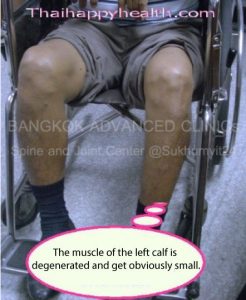
The symptoms begin with a tight-pain at the back of the thigh (hamstring tightness). Some will feel the shooting pain down to the calf (radicular pain). If somebody has suffered slippage of the vertebra they may not be able to bend forward, or after sitting for quite a long time, they will not be able to walk immediately after standing up. They often need to wait and straighten there prior to walking. If examined closely a curve or hump in the back is more exaggerated (hyperlordotic curve). If the vertebrate slip out of place and press on the surrounding nerves, the patient will be unable to take a long walk due to the pain that occurs in the legs and calves. If the symptoms have been neglected for a long time without any treatment, the nerve can become further deteriorated due to inflammation and lack of blood circulation. The muscles will get smaller and weaker (muscle atrophy).
Later, I will explain about the steps to take to prevent and to help cure back pain, including the use of new technology in surgical operations to reposition slipped vertebrate back to the normal condition or position, or even better than before.
