Recently there has been a new, revolutionary way of thinking towards the treatment of bowed-legs. Patients can wear specially designed shoes that are tailored to a patient’s particular needs and can therefore produce a change to the legs / knee structure. These custom made shoes, featuring patient specific insoles, can adjust the structure of the horizontal plane and the angle and the length of the legs. Fortunately, they can be fit as soon as the child is able to walk. Furthermore, they are also effective in elderly patients, where they can provide increased support in weaker areas.

Bow legs (or bow knees) and knock-knee in children Treatments
Knee Brace: The purpose of the brace is so that, when weight is applied through walking, increased pressure is put on the leg so that the knee is bent out. With better materials and new developments in 3D printing technology, the brace can now be customized so that it can quickly adapt to the child’s knee structure. It is of high elasticity and can also be adjusted to the colliding (push and pull) pressure of the leg. It configures the knees to the desired shape. The brace only needs to be worn when a child is standing up or walking. It is not necessary to wear all the time and to be taken off when the child goes to bed.
Elderly patients with degenerative knee joints, who may also have a bowleg / knee or knock-knee problem, do not always feel comfortable having an operation. In these circumstances, the knee-brace can offer relief from their condition. The brace helps support the knee by reducing the bumping force and knee pain. It also helps the patient to walk properly again. The disadvantage is the high cost of the brace, especially if it is imported; this kind of brace is made of a high quality material, which is neither too hard nor too stiff. It also fe atures a good design, and has a tension-adjusting knob to put force on the knees / legs when a patient stands up and walks. The tension can be released when sitting down.

A Knee Brace, where the tension can be adjusted to bend the knee back to a straight position. It can also be used in elderly patients who have acquired bowlegs from degenerative knees. Recently knee braces are better designed and made of a more effective material than in previous years.
Thanks for the information from Bangkok Advanced Clinics
These splints are for small children. The splint (whole-leg brace) puts added pressure on the knees, making them “bend out”. In this situation, the child is able to walk; however, a common problem is how to keep the brace clean. The child can also sometimes make the brace dirty when urinating or defecating. For these reasons, the young patient will need to periodically change the splint and see the doctor to monitor their condition.

Body balancing shoes
Wearing body balancing shoes is a new choice of treatment. The shoes or insoles that are custom-made can adjust the structure of the horizontal plane, the angle and the length of the legs. Furthermore, they can be created as soon as the child is able to walk and are also suitable for elderly patients.

The principle is to use the pressure of the body weight and the walking tension as a bending force on the knee joints. This stimulates the leg muscle to work more properly, creates more balance in the body and also lessens and moves the abnormal colliding force on the joints of different sites (ankle, knee, hip and back).
Moreover, body balancing shoes can also be worn by people who are not afflicted with knee problems. For example, sportsmen can help to improve their present status to a better condition by wearing shoes of this type because they are more finely-tuned to the requirements of their specific body structure.


The pictures show the fitting of body balancing shoes for a young golfer


These pictures show the measurement of the sole pressure, when taking walking steps

This shows a patient with degenerative knees problem having their customized shoes fitted
What are the advantages wearing structure-adjusting shoes?
There are many advantages of wearing these special, customized shoes:
They are Convenient
Body balancing shoes can be made to fit people of all ages: toddlers, teenagers, adults and seniors. As mentioned previously, elderly people can contract bowlegs from the degeneration of the knee joints. The earlier the shoes can be fitted, the more effective the shoes will be with more satisfying results to the patient. The shoes also lessen the damage of the muscle, tendon and cartilage from the impact of the bow knees or knock-knee. The structure adjusting insole or shoes are safe and convenient to use. The insole can be put inside regular shoes and will not disturb daily routines. When wearing the structure adjusting insoles / shoes a person can live a normal life, doing activities as usual. They also produce better results for the sport activities that involve the use of knees, because they can lessen the abnormal vibration force pressed on various joints.

Body Structure is improved
The body balancing shoes can also help adjust the structure of other parts of the body, allowing them to return to a more balanced state, such as in the case of an inclined hip bone or a crooked back bone (which can be formed as the result of a crooked structure of the legs) or when one of the shoulders is inclined more than another (giving a droopy look).
Self-confidence is not affected
The individual will not feel inferior about how they look as the shoes are much less obvious to see than when a patient is using other supports such as a splint or knee brace. The child can do daily activities alongside their peers and feel equal to them, with no limitations from wearing the shoes.

The x-ray pictures above are of a 3 year old boy, after 6 months of wearing the body balancing shoes. The following positive effects can be seen:
- The knock-knee straightens up and becomes normal
- The legs that were 1cm. different in length are now of the same length
- The crooked back bone was adjusted and has become straighter
Shoe Fitting
The critical point of the treatment is that it has to be under close supervision of the orthopedic doctor who has the necessary expertise needed when adjusting the structure of the legs, knees and back. As the child continues to develop, it is vital to change the shoes or the insoles many times whilst the feet, knees and back continue to grow. This is especially true for toddlers where during the ages of 7-12 years old there will be many changes in the shape structure of these body parts. In some circumstances, it may be necessary to change the shoes up 2-3 times in one year.
The 5 steps of fitting the body balancing shoes
1. An examination of the body structure is carried out by the orthopedic doctor, who is an expert in body structure adjusting.
2. X-Ray the structure of the backbone, hip and the whole leg (Scanogram) by a Full Digital X-Ray machine. The software of the machine takes the detail measurements of length, different angles and area. In some cases, it might be necessary to have a 3D CT or MRI scan to precisely cover all the relevant information of the body structure.
3. Evaluate the information taken by the expert orthopedic doctor.
4. Static (standing) and Dynamic (walking) Model Printing
5. Consultation with the Orthopedic Shoe Designer, where custom made shoes are fitted according to unique specifications of patient.
After gathering all of the information, the shoes or the insole will be made accordingly. When the shoes are released to the patient, the 5 step process will be reviewed again to make sure that the shoes / insole complies with the individual’s unique requirements. The procedure of creating the shoes will usually take about 2-4 weeks in total. After that, the doctor will make the appointment periodically, to check on the patient’s condition and the effectiveness of the treatment. In toddlers, this can be every 6 months. Finally, if it is unavoidable, it is necessary to go through the surgery to straighten the knees. There are many operation methods that fit toddlers and teenagers.

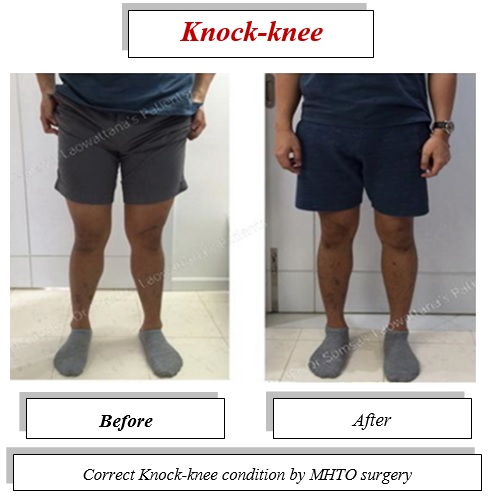
We will give further details of the various different methods of the surgery on other occasions.

Related Articles
Part 1 Bow legs (or bow knees) and knock-knee in children
Part 2 Bow legs (or bow knees) and knock-knee in children