CTS (Carpal Tunnel syndrome) are commonly found in middle aged women. The symptom starts with the numbness of the finger tip when used continuously for a period of time e.g driving, holding the cooking spatula or even holding the cell phone. The fingers often found with the symptom are the index, the middle and the ring fingers. After having the symptom on and off for some time, without having the right treatment, the numbness will increase in degree followed by streaking pain from the wrist that spreads up to the forearm.
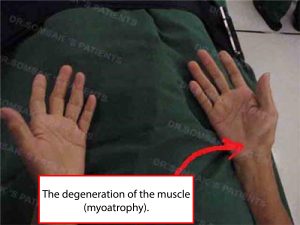
As the patient ignores and tries to tolerate the pain and numbmess, the muscle of the palm will start to wilt and becomes emaciated. The worst case scenario would be loss of grip strength as well as not able to hold even small things.
The carpal tunnel is a narrow passageway of ligament and bones at the base of your hand. It contains nerve and tendons. Sometimes, the thickening from irritated tendons or from other swelling narrows the tunnel and causes the nerve to be compressed. Human palms have an important nerve called Median nerve that controls the feeling (sensation) of the index, the middle and the ring fingers. The Median nerve also simulates the strength of the palm to operate a normal movement.
When there is a thickening of ligament surrounding the area that strikes the nerve, the blood vessel will be compressed and the supply of nutrients through the blood will also be restricted. The nerve cell is gradually degraded and the mentioned symptoms occur.
The most important point in the treatment is the diagnosis step. The right diagnosis will tell if it is indeed Carpal Tunnel Syndrome (CTS) and at what stage. This needs to be done by the experienced doctors with the help of the instrumental test EMG (Electro Myo-graphic Test) before proceeding with the treatment.
There are 3 kinds of CTS treatment
1. Taking medicines: This is for the case that just started; having only little of the numbness or numbness that is on and off. The Anti-inflamation medicine can reduce the swelling of the nerve or the patient can take the nerve-nourishing vitamin i.e. (Vitamin B Complex and Concentration Vitamin B12). The recovery chance is 60-70%
2. The injection: Injection of steroid into the palm at the area where the nerve is pressed will lessen the swelling and inflammation. The benefit of injecting steroid is that there is little side effect; quickly reduces the pain and the numbness. The treatment is prohibited in pregnant women because taking any anti-inflamation medicine will put the fetus development at risk. The down side of the steroidal treatment is that the injection is a bit painful and it cannot completely get rid of the thicken ligament developed. The injection will give only temporaty relief and the pain can come back. The recovery rate is similar to the taking of medicine.
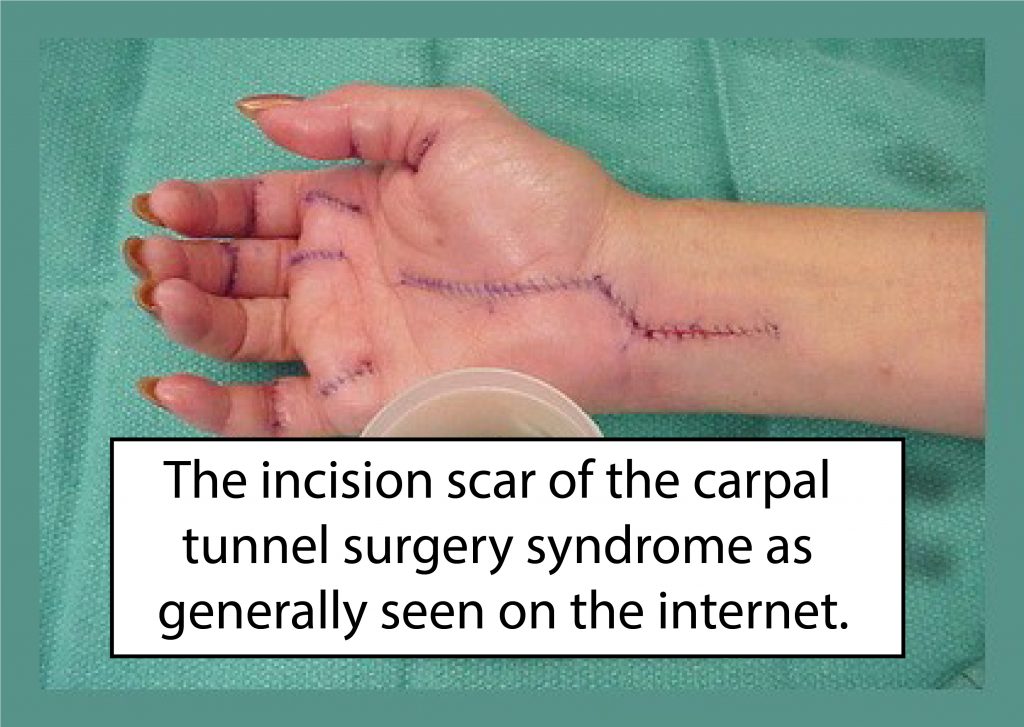
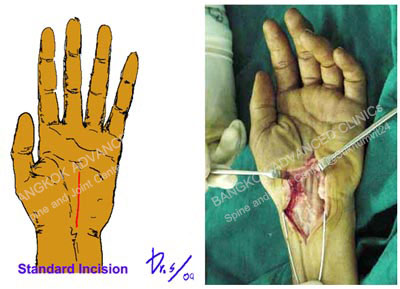
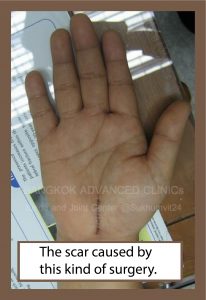
3. Operation: The operation is to take out the ligament, which directly compresses the nerve. The nerve can then get the blood supply and thus, revived. This needs the identification of the operation site by the surgeon. The standard procedure is to open the vertical cut at the middle of the palm (as in the picture below).
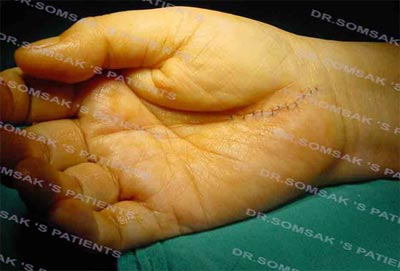
The problem though is not totally taken care of. Some patients’ sulture, seam of the operation, will be thicken and convexed. This scar will make the palm more sensitive to sensation and pain. The way out is to use the alternative operation technique,
Minimal Scar Surgery Technique consists of two (2) major parts:
1. Minimal Scar Incision: The opening of the cut will not be done at the middle of the palm, but will be on the skin layer at the “Life- line†on the palm (picture). The line on the palm is deepening in the palm so the cut will not be prominent. And the opportunity of developing the scar is less.
2. Minimal Scar Technique consist of:
- Anatomical Opening: The opening of the cut according to the inner muscle anatomy of the palm will lessen the chanches to cut the small arteries, thus less bleeding. It will also lessen the fascia and scar development which is the revival process of the wound caused by the muscle fiber cut
- No Cautery Machine Since the bleeding will be minimal, there is no need to use the electrosurgical unit to stop the bleeding. The electrosurgical unit uses electricity to burn the tissue at the cut, which will be melted and clog the bleeding wound. The side effect is that the surrounding tissue will also be burnt, form the scar. To operate without the electrosurgical unit, the patient will have less fascia-scar and less pain.
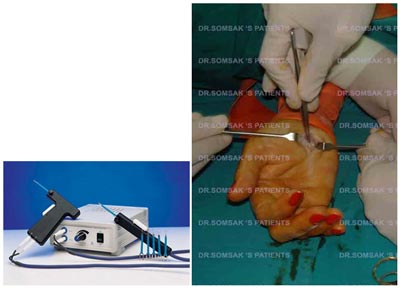
- Minimal Size of Suture Material The sultur thread used is a small size (sometimes the one used for face operation) The size of the wound is very small, the stitches are small and will not be thickened and convexed.
- Minimal Movement Stabilization: After the surgery, the soft-sprinter will be temporary put on to lessen the force on the wound so that the palm nerve will be revived quickly and no fascia-scar is formed.
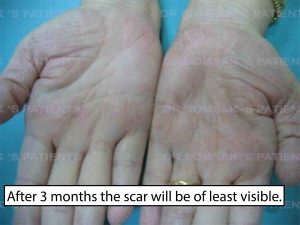
Above all, there are more factors of concern that will cause the scars e.g. genetics, the ones with darker complexion will be more prone to develop scars; taking good care of the wound will not lead to infection; not using the operated hand before the wound is healed, etc.
The important point is that apart from the small scars, the palm nerve that needs to be treated will be back to normal. Then the operation can be called a success.